This month we profile ten of the best, and today it’s the turn of ELLIE RAESIDE of Tonic in Edinburgh and JOHNNY MORRISON of Glasgow’s Blue Dog.
ELLIE RAESIDE Tonic Edinburgh
Ellie, 22, won the William Grant & Sons Bar Apprentice Award at the 2018 Scottish Bar & Pub Awards. At the time she was working at Edinburgh’s Candy Bar but has since moved to the city’s Tonic Bar. Said Ellie, “I fell in love with bartending from my very first job at The Roseburn Bar in Edinburgh which can best be described as a wee old man’s pub.
“Interacting with the customers is definitely one of highlights of the job – as well as being a bit of a challeng sometimes too.”
And it seems that bartending runs in the family.
Explained Ellie, “I learned a lot from, as well as greatly admire, my sister Poppy who has worked in cocktail bars for years. My first manager at The Candy Bar, Neil Bowie, was also a really great support and inspired me to really push myself. He’s now at Malones”
JOHNNY MORRISON Blue Dog Glasgow
Johnny has been working at Blue Dog for four years, as well as running his own cocktail consultancy and events company on the side. At the moment he’s interested in molecular mixology.
He explained, “I’m fascinated with how chemicals and other ingredients can alter the flavour and consistency of the liquid.”
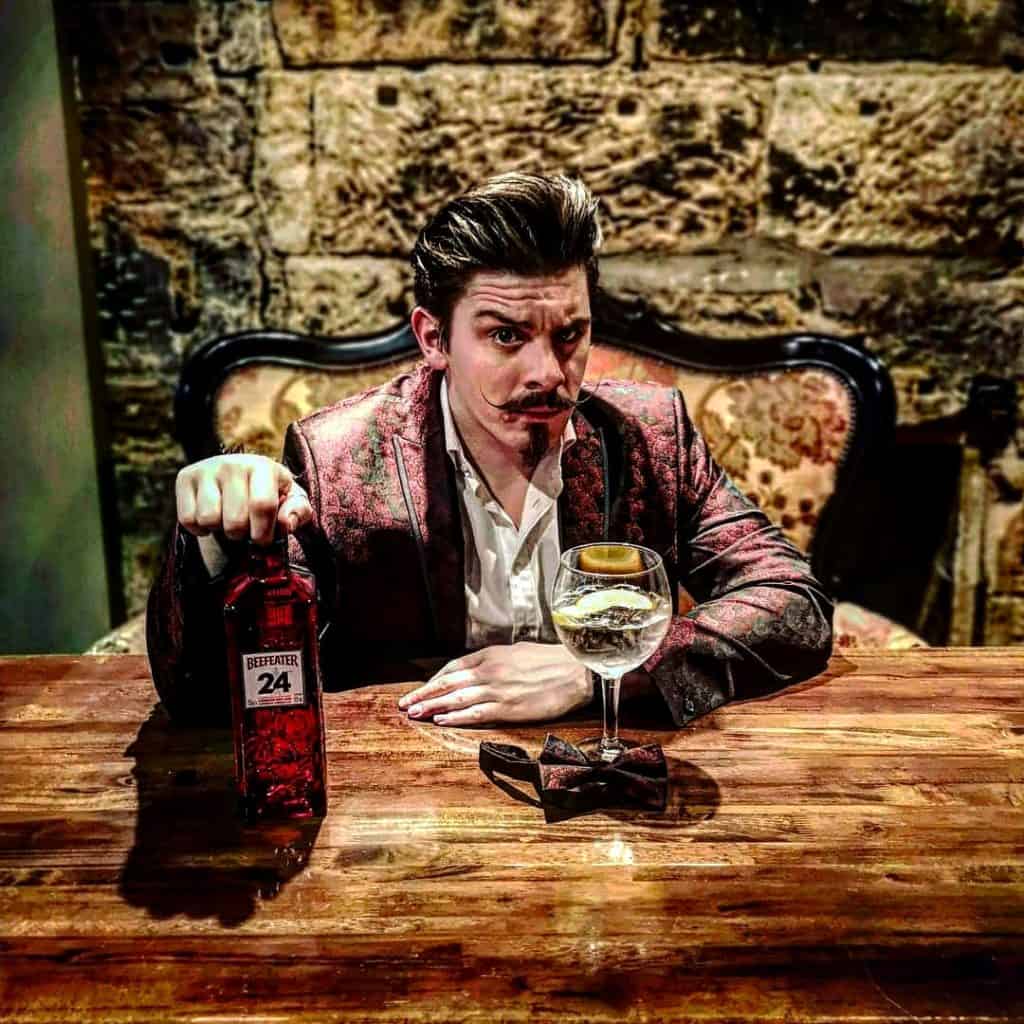
He’s also fresh back from London after winning a cocktail competition organised by Beefeater gin, while Johnny admires an operation a little closer to home and a mixologist a little farther afield. He explained, “I really like what the guys at Glasgow’s Tikki Bar do as well as what a mixologist from the USA, Saeed House (aka Hawk), is doing on social media.”
What does the future hold for Johnny career-wise? “I’d love to have my own bar in Glasgow and I’ve got loads of ideas percolating but that’s about five years or so away from materialising, I’d say.”
St Valentine was a real person named Valentinus – from the Latin word meaning worthy, strong and powerful – who was martyred in 270 AD, but there is some confusion around his true identity. One account from the 1400s describes him as a priest who was beheaded near Rome for helping Christian couples to marry. A second account claims he was a Bishop who was also martyred on the outskirts of Rome. The similarities between these accounts could mean that they refer to the same person.
In all there are about a dozen St Valentines, and even a Pope Valentine but the one we celebrate on February 14 is known as St Valentine of Rome to differentiate him from the others on the list.
The most recently beatified Valentine is St Valentine Berrio-Ochoa, a Spaniard who travelled to Vietnam and served as a bishop there until he was beheaded in 1861. Pope John Paul II canonized him in 1988.
Little is known about Pope Valentine – perhaps because he served just 40 days in AD 827.
Cadenhead’s Old Raj Gin is distinctive in that it contains a measure of saffron, the rare and costly spice derived from the crocus flower. In addition to a slightly spicy flavour, this also imparts a pale yellow colour to Old Raj. The addition of saffron is undertaken personally by the Company master blender in order to ensure a consistency in flavour and colour each time Old Raj is bottled. Being a much loved Scottish gin, it’s definitely a brand worth stocking.
In South Korea it is women who give their men chocolates on this day. In return, men give them gifts on March 14 – which is known as ‘White Day’. The tradition has been extended to include a ‘Black Day’ when singles who didn’t receive a Valentines gift mourn their solitary status by eating bowls of black noodles a month later, on April 14.
In Denmark lovers exchange pressed snowdrops and men also give women a funny poem or rhyming love note – called a Gaekkebrev – which is signed with anonymous dots representing each letter of the sender’s name. If the woman correctly guesses who the card is from she earns herself an Easter egg later that year.
In South American countries like Colombia, Mexico and Costa Rica people perform ‘acts of appreciation’ for friends and loved ones rather than giving cards or gifts on Valentine’s Day.
Women in South Africa pin the name of their love interest on their shirt sleeve on Valentine’s Day.
we love Prosecco Prosecco sales overtook Champagne sales for the first time in 2014, and Prosecco sales are still in growth, with 2/3 sparkling wine drinkers in the UK drinking it at least once per month. Mind you that is hardly surprising when you see the effort put, not just into producing a great drink, but fabulous bottles too. The most glamourous of all is Bottega Gold and Bottega Rose Gold. They have been created by Bottega Sparkling Spa, a family owned wine business, based in Veneto. It produces 10 million bottles every year, with sales in 110 countries, 400 customers and 380 distributors worldwide. Bottega Gold is a DOC Prosecco while Bottega Rose Gold is a sparkling 100% Pinot Noir. Both bottles get their stand out looks because they are dipped in a molten metal base coat, then covered in their respective coloured metallic paint. Talk about stand out. both bottles have bar and table presence. We love them. To enquire about stocking Bottega contact Catalyst Brands on 0845 856000
The Welsh celebrate St Dwynwen’s Day (the patron saint of lovers) on January 25, instead of St Valentine’s Day. Wooden love spoons, carved with special designs, were traditionally given by men to ladies whom they wished to court or marry. A key signifies a man’s heart, wheels his hard work and beads the number of children he would like to have.
Single women in England used to place five bay leaves in their pillows – one at each corner and one in the centre, on the eve of St Valentine’s Day, in the hope that it would bring dreams of their future husbands.
Around 7% of Scots send a card to someone who is not their spouse or partner – either a platonic friend or a family member. Meanwhile just 2% have are likely to send a card to someone they would like to be in a relationship with, but are not currently. Around 35% of Scots will send a Valentine’s card to their spouse or partner, and 15% will cook a special romantic meal at home (YouGov).
Stock up on pink on February 14 Perfect for Valentine’s Day, Pinkster is a premium gin produced with fresh raspberries. It’s deliciously dry, with a hint of fruit and an exceptionally smooth finish For a refreshingly different G&T, serve Pinkster with a premium tonic, a raspberry and a sprig of fresh mint. Be sure to spank the mint first to release the aromas. Last year Pinkster was voted the UK’s third favourite gin in a Craft Gin Club poll featuring over 100 gin brands. Pinkster is available from leading wholesalers including Gordon and MacPhail, Master Of Malt, and Royal Mile Whiskies. www.pinkstergin.com @pinkstergin #spankthemint
Music by Celine Dion is apparently the top choice for almost a quarter of romantic Brits on Valentine’s Day – followed by tunes by Phil Collins and Frank Sinatra
(Ipsos MORI).
1/10 People have never sent a Valentine’s Day card or gift
1/5 People send Valentine’s Day cards to friends and family members to make them feel good about themselves (Ipsos MORI).
Not surprisingly, Valentine is the patron saint of engaged couples and happy marriages but he is also called on for interventions regarding such diverse issues as beekeeping, epilepsy, the plague, fainting and travelling.
2016 will see one of Scotland’s most popular beer brands, McEwan’s, reach 160 years old. Lovers of the McEwan’s range of beers will have the chance to join in with the celebrations with a number of events and giveaways throughout the year. For instance McEwan’s Export drinkers will have a 1 in 4 chance to win a limited edition 160th anniversary pint glass, and there will be a number of other giveaways across McEwan’s social media throughout the year. There will also be celebrations at McEwan’s Party at the Palace – the Linlithgow music festival which takes place on 13th and 14th August.
The ongoing success of McEwan’s is also down to the evolution of McEwan’s beers to keep up with the demands of modern drinkers. The latest result of this is McEwan’s IPA which was launched last year. Tara Karimian, Marketing Manager for McEwan’s Beers, “It’s a great time to be a McEwan’s drinker.”
St Valentine’s skull, adorned with flowers, is on display in the Basilica of Santa Maria in Cosmedin, Rome, but part of his arm is in Glasgow.
In the early 1800s skeletal remains and relics associated with St Valentine were unearthed in a catacomb near Rome and many were later distributed around the world. One of these relics – thought to be one of his forearms – now lies in Blessed John Duns Scotus Church in the Gorbals, encased in a 3ft-wide wooden chest, or reliquary. Men sometimes bring their partners to the church to propose beside it on February 14. Other relics belonging to the saint are to be found in Ireland, England, France, Malta and the Czech Republic.
Valentine’s Day is only the third sexiest night of the year – behind wedding anniversaries and birthdays (Ipsos MORI). In Scotland, couples say they are more likely to get passionate with a partner on Christmas Day.
The most popular choice of Valentine’s gift is a weekend getaway – with 30 per cent of adults saying that is the gift they would most like to receive.
However, most are likely to be disappointed as 42 per cent of men usually buy flowers for their loved one, while women are more likely to give their man aftershave (11 per cent) or chocolates (eight per cent) according to an Ipsos MORI poll.
Around 1.3 million adults (3%) in Britain have proposed, or been proposed to, on Valentine’s Day and nearly a million adults have said ‘I love you’ for the first time on the day (Ipsos MORI).
Ryan Snedden from Tonic, Edinburgh, is Scotland’s representative in the UK final of this year’s BACARDÍ Legacy Cocktail Competition which takes place in London on 10th November.
Eight bartenders were selected to go through to the national final during the five regional heats, which were held in London, Edinburgh, Bristol, Manchester and Belfast during September.
The regional winners will go head-to-head in the UK final in front of a panel of industry experts, including global rum ambassador, Ian Burrell; The Savoy’s Chris Moore; BACARDÍ Brown-Forman Brands’ Head of UK Trade Advocacy, Marc Plumridge; and BACARDÍ Global Ambassador, Dickie Cullimore. The final three will then receive a budget to execute a promotional campaign to generate support for their BACARDÍ cocktail over the following four months. The bartender with the most successful campaign will then compete against top bartenders from around the world in the global final of the BACARDÍ Legacy Cocktail Competition, taking place in San Francisco in April 2016. .
Robin Honhold from the Lucky Liquor Co. in Edinburgh, has secured a place in the UK final of the global bartender competition, Diageo Reserve World Class. He beat fellow Scottish bartenders Michael Braun of Panda and Sons; Mike Lynch, of the Devil’s Advocate; Euan Halliday of Tigerlily; Russell Downie of Tonic and Matt Wakeford, Missoni to secure the his place.
Other contenders who also go forward are Matthew Soares from Cloud 23 in Manchester, Nathan O’Neill from Milk and Honey in London and James Fowler from The Larder House in Bournemouth. The four bartenders now proceed to the next stage of the competition and are one step closer to the global final.
Diageo Reserve launched this year’s competition with introductory and educational forums across the UK in October, after which all those who attended were invited to submit their cocktail recipe to the judges. Mystery shoppers were sent to observe each entrant, ensuring their bartending skills extended to a high level of service, as well as fantastic drinks. The panel of expert judges, made up of drinks journalists and Diageo Reserve brand ambassadors including Andrea Montegue and Deano Moncrieffe, were then tasked with agreeing which of the talented contestants would go through to the UK final.
Imaginative cocktail recipes included the Engine Room from Robin Honhold which comprised Johnnie Walker Gold Label Reserve mixed with ingredients such as grapefruit oil and a homemade violet tincture, to create an incredibly well balanced drink with interesting flavours, served in branded bottles with a glass on the side.
Deano Moncrieffe, Diageo Reserve brand ambassador and World Class judge, said, “Competition this year was incredibly tough. To win World Class is the ultimate accolade for a bartender so they really pull out all the stops and we’ve seen some incredible talent that is really pushing the boundaries of expert bartending and fine drinks in the UK. It’s shaping up to be an outstanding year and we have some real potential in the UK to see our bartenders go far in the competition.”
A second burst of UK activity in March will see further introductory forums take place in Glasgow, Liverpool, London and the south, with the second burst of regional finals taking place in May. One bartender from each of the heats will then compete in the UK finals, with the overall winner joining the most esteemed bartenders from around the world to contest the ultimate accolade of World Class Bartender of the Year at the Global Final in July 2014. The global final is held in an incredible location somewhere in the world, which in the past has included India and Rio. The 2014 global final location is yet to be announced.
 Cadenhead’s Old Raj Gin is distinctive in that it contains a measure of saffron, the rare and costly spice derived from the crocus flower. In addition to a slightly spicy flavour, this also imparts a pale yellow colour to Old Raj. The addition of saffron is undertaken personally by the Company master blender in order to ensure a consistency in flavour and colour each time Old Raj is bottled. Being a much loved Scottish gin, it’s definitely a brand worth stocking.
 we love Prosecco
 Stock up on pink on February 14
 2016 will see one of Scotland’s most popular beer brands, McEwan’s, reach 160 years old. Lovers of the McEwan’s range of beers will have the chance to join in with the celebrations with a number of events and giveaways throughout the year. For instance McEwan’s Export drinkers will have a 1 in 4 chance to win a limited edition 160th anniversary pint glass, and there will be a number of other giveaways across McEwan’s social media throughout the year. There will also be celebrations at McEwan’s Party at the Palace – the Linlithgow music festival which takes place on 13th and 14th August.