Scottish independent brewer, Innis & Gunn, has rolled out its Beer Kitchen concept to 80 North Street in St Andrews, replacing The Glass House restaurant. The company opened its third Beer Kitchen at the end of November. It follows successful Beer Kitchen openings in Dundee and Edinburgh.
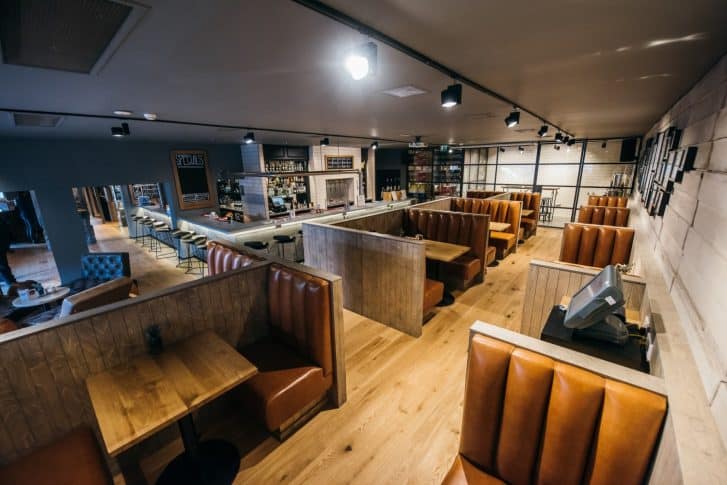
Designed by Guy Morgan from Morgan McDonnell Architects, the bar restaurant hosts 12 different beer taps and a large selection of bottled and canned craft beers.
Dougal Sharp, Founder and Master Brewer at Innis & Gunn, said, “Each new Beer Kitchen gives us a chance to introduce great craft beer to a new audience. It’s always rewarding to bring this to another town and I’m looking forward to giving St Andrews a new place to enjoy craft beer.”
Innis & Gunn will also open its biggest bar to date in Glasgow in Spring 2017, which will include an on-site brewing facility.
Scottish craft brewer Innis & Gunn has hit its crowdfunding target of £1m in just three days.
The Edinburgh-based company launched its equity crowdfunding campaign, AdventureCapital, to the public on 1 November, offering a 2% equity stake in return for investment to back its future plans for expansion.
So far, 763 investors have pledged £1,151,110 and it is now “overfunding” with 25 days remaining, meaning Innis & Gunn will accept further investment in exchange for releasing additional equity.
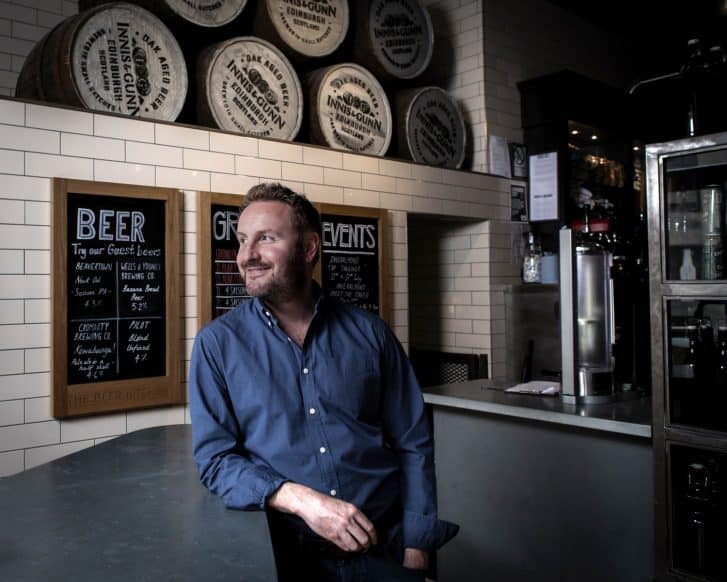
Dougal Gunn Sharp, Founder and Master Brewer at Innis & Gunn (pictured above), said response has been “overwhelming”.
He said, “We did not expect to reach the target in such a short time, we are absolutely thrilled, and grateful to all of our investors so far – we can’t wait to get started on this next chapter together.
“Making great craft beer has been at the heart of this crowdfunding campaign, so it’s been excellent sharing our passions with so many investors.
“Every penny we raise is going to grow our potential to make even more great beer.”
Innis & Gunn intends to double its turnover to £25 million over the next three years.
The money raised through AdventureCapital will fund the brewer’s plans to roll-out its bar and restaurant brand, The Beer Kitchen. Last month, the company announced plans to open a third Beer Kitchen in St Andrews in November, following successful opening in Dundee and Edinburgh.
A future four sites are planned for 2017, including one in Glasgow, which will house the company’s first micro-brewery, and its first international venue in Toronto, Canada.
The investment will also support continued experimentation with beers, and increase capacity at its newly acquired Inveralmond Brewery in Perth, which has been renamed Innis & Gunn Brewery. Read more here.
Scottish independent brewer, Innis & Gunn, has announced plans to open its third Beer Kitchen in St Andrews in mid-November at 80 North Street.
The company will also open its biggest bar to date in Glasgow in spring 2017, which will include an on-site brewing facility. A venue has been agreed on, with work scheduled to begin in January next year.
The Beer Kitchen St Andrews will offer 14 different beer taps and a selection of bottled and canned beers. Work on the new bar, located near St Andrews University campus, is now underway with Guy Morgan from Morgan McDonnell Architects providing the design.
It follows an ‘exceptional’ year in business for the brewer’s current Beer Kitchens in Edinburgh, opened in 2015, and Dundee, which launched earlier this year.
Dougal Sharp, Founder and Master Brewer at Innis & Gunn, said, “Each new Beer Kitchen gives us a chance to introduce great craft beer to a new audience. We want our Beer Kitchens to be known as spaces where amazing beer and food can be enjoyed. It’s always rewarding to bring this to another town and I’m looking forward to giving St Andrews a new place to enjoy craft beer.”
Innis & Gunn’s Beer Kitchen concept won the New Casual Dining Concept of the Year Award at the Casual Dining Awards earlier in this year.
David Hall, MD of Innis & Gunn Retail, added, “Edinburgh and Dundee have proved to be a successful start for our retail business. We seized on the opportunity to make St Andrews our third opening and are excited to showcase our beers in the town. We’ll be making plenty of Innis & Gunn beers available at the new bar, will continue to host tap takeovers with other breweries and test new and exclusive beer recipes on-site.
“Opening up a new venue in St Andrews will be an integral step in developing the retail business further. The Beer Kitchen concept has proven successful and next year we’ll be building our biggest venue in Glasgow and taking the format overseas, with a Beer Kitchen in Toronto, Canada, our largest international market.”
The brewer’s future opening in Glasgow will lead the next wave of Beer Kitchens, with another three locations planned for 2017, including Innis & Gunn’s first international Beer Kitchen in Toronto, Canada.
Innis & Gunn is planning to launch its second bar & restaurant venue, The Beer Kitchen by Innis & Gunn, in Dundee. The company aims to build on the success of the brand’s first site in Edinburgh which opened last summer. Innis & Gunn’s, Founder and Master Brewer, Dougal Sharp said, “Dundee is a vibrant, thriving city and with the huge redevelopment that’s happening it was always top of our list of cities to launch in as soon as we could. We want to open Dundonian drinkers’ eyes to what real beer means to us at Innis & Gunn, in our own relaxed way that’s worked really well for us at our first venue in Edinburgh. We’ve zero tolerance for second rate, tasteless beer but our bars are not about us dictating personal taste – we want our venues to change the world of beer for the better by being flag wavers for incredible, flavor packed brews, not fixated on selling ‘flash in the pan’ beers that are all beard and no trousers. It’s our no nonsense approach to quality and real flavor in our beers and food that we hope will go down well with the good folk of Dundee.”
Architects Morgan McDonnell have been briefed to roll out the brand’s relaxed Scandi- Scottish style interior design at the venue at 10 South Tay Street, which alongside the Edinburgh premises, is G1 owned. The 3,700 square feet site will feature limited edition oak aged cask beers in an exposed beer cellar and 2 x 5 hectolitre tanks serving Innis & Gunn’s award-winning unpasteurized lager fresh from the brewery. The kitchen offering will include pub classics with a beer ‘flavor’, alongside chopped and charred and low and slow style dishes. David Hall, is the man in charge of the roll out of the concept, and he is planning another two sites by the end of 2016.
Innis & Gunn has announced the appointment of James Coyle as Managing Director. Coyle, who was formerly Deputy Managing Director of Marston’s Plc, will oversee all areas of the Innis & Gunn Brewing Co, including International expansion and the roll-out of the company’s newly launched retail operation arm, The Beer Kitchen by Innis & Gunn.
In February 2015, he joined Innis & Gunn as a non-exec Director but has been a long-standing supporter and advocate of the Innis & Gunn business.
Dougal Sharp, Founder & Master Brewer of Innis & Gunn, commented, “James has an unparalleled wealth of experience in the brewing and bars business and has been a true supporter of ours since our launch in 2003. As his career has moved on he has always maintained a strong professional interest in our progress and as a result, this next step feels entirely right for us, during a monumental year for the business. This year we saw the launch of our first crowd funding initiative, The Innis & Gunn BeerBond, where we successfully raised our target of £3M to help us build a new state of the art brewery in Scotland. We’ve also opened our first bar and restaurant in Edinburgh, The Beer Kitchen by Innis & Gunn, with plans underway to have another 2 outlets opened in the UK by spring 2016. James’ vast experience will be invaluable in helping us realise our ambitions for the business and drive the global acceleration of our brands to the next level.”
The independent brewer, known for its innovative and oak-aged crafted beers, has been at the forefront of the British craft beer scene for over a decade, and has had a relationship with Coyle from 2003 when he helped launch its flagship beer, Innis & Gunn Original, to the UK market.
James has worked in the beer industry for twenty years, first joining Marston’s to set up a new Take Home and Export division in 1995. Following almost a decade at Wychwood Brewery (latterly Refresh), where he was instrumental in the development of Hobgoblin plus a range of innovative beer brands, he also helped expand Wychwood’s managed retail estate to 30 units. In 2003 he played a key part in bringing Innis & Gunn to the UK market, overseeing the launch and UK Distribution Agreement through Wychwood Brewery. Following the acquisition of Wychwood in 2008, James returned to Marston’s as National Sales & Marketing Director before taking the role of Deputy Managing Director.
Commenting on his appointment, James Coyle said: “Innis & Gunn is a truly entrepreneurial business that has already had huge success in taking its remarkable beers to an international audience. I have known and worked with Dougal for many years and am thrilled to be joining the company at a time where the global appetite for innovative, flavour packed beers has never been greater. My goal is to further bolster the global appeal and availability of the company’s craft beer brands and contribute to the business’s mission of changing the world of beer for the better”.
Eight independent brewers – Cairngorm Brewery, Fyne Ales, Harviestoun, Innis & Gunn, Inveralmond Brewery, Stewart Brewing, WEST and Williams Bros have joined forces to create The Brewers’ Association of Scotland (TBAS), to support, promote and safeguard the future of the industry.
TBAS Chairman Dougal Sharp, CEO of Innis & Gunn said, “The Scottish beer industry is thriving and opportunities abound within Scotland and Internationally.
“It is important to our sector, now more than ever, that we have an effective industry body to help us to achieve our individual business aspirations. Until now the industry has had no governing body in Scotland, whereas in other countries where there are similar associations the benefits of such a body are clear. More choice, greater levels of consumer awareness and understanding, high quality, higher growth and levels of business, all underpinned by targeted support from local governmental agencies.”
TBAS aims to deliver a group identity and quality standard for craft brewers across Scotland: artisanal brewers that are predominately Scottish owned and brew less than 200,000 hectolitres per annum in Scotland or within their group of companies. The key objectives of the Association are founded on seven fundamental principles: quality, promotion, market development, representation, accreditation, innovation and common interest grouping.
It is estimated there are now between 80-90 independent breweries in Scotland. The TBAS founder breweries employ 246 staff in Scotland between them with a combined turnover (latest accounts) of over £30m. The project is being facilitated by the Market Driven Supply Chain Project – jointly funded by the Scottish Government and Scottish Enterprise, and delivered by SAOS, with additional support from The Community Food Fund.
Commenting on the initiative, Richard Lochhead, Cabinet Secretary for Rural Affairs, Food and the Environment, said, “Craft beer is becoming increasingly popular both at home and abroad and it is great to see Scottish artisan beer in such high demand.”
He continued, “It is important that – as the sector expands – those working in this business understand how they can capitalize through collaboration, to make the step changes to create strong, diverse businesses with national and global ambitions. I believe TBAS can make a strong contribution in this regard and I wish them every success. I’m delighted to be speaking to the founders at the Scottish Parliament tonight, during Scotland’s Year of Food and Drink, and look forward to seeing the outcome of their consultation.”
Whether you’re an avid fan of football or simply can’t stand the sight of it, there will be no getting away from the beautiful game come June 12th, when the 2014 World Cup kicks off in Brazil. Jamie Allan reports.
Licensees can expect to see a spike in beer sales during June and July, as live football and beer have long been established in the public’s imagination as an old married couple, paired together for longer than anyone can remember and unquestionably inseparable. DRAM takes a look at the upcoming World Cup, before focusing on the recent boom in both the world and craft beer categories.
The volume of world beers now available to Scottish bars is astonishing; Inverarity Morton stock in excess of 50, Dunn’s have approximately 70 available at any one time, speciality supplier Dameck carries just under 1000 world beers and online wholesaler Beers of Europe can despatch up to 1600 brands to your bar’s doorstep at the touch of a button.
That so many beers are now readily available in the Scottish on-trade demonstrates the growth of the world beer category in recent years. Ian Risby, Divisional Manager of the McEwan’s Beer Company, told DRAM that the continuing success of world beers in the on-trade presents an excellent opportunity for licensees to boost sales and increase profit margins. He said, “World and specialist lager continues to be a star performer in Scotland and the category is now worth £101million with sales up 6%, with the share of the On Trade beer market at 11.8%. With more choice available, consumers have become increasingly discerning and we are seeing a shift in habits with lager drinkers moving away from the mainstream in search of more premium beers which have authenticity, character and essentially offer a better experience.”
Faced with such a wide choice, the difficulty for licensees can be in deciding which beers are right for their bars. International brands such as Sol, Corona and Peroni for example are now fairly established in the Scottish on trade, providing high-volume sales and a healthy profit margin. The risk lies in ordering in products unfamiliar to the bar’s clientele that may ultimately sit gathering dust on the shelves. Furthermore, many beers from countries such as Belgium and the US can be prohibitively expensive and difficult to retail without taking a hit on the GP, leaving the bar operator to decide whether the attraction and talking point that a large beer selection brings is worth the reduced margins that follow.
One thing licensees can be sure of during the tournament is increased footfall. In their FIFA World Cup Hints and Tips brochure, official sponsor Budweiser states that 75% of the UK adult population will watch the 2014 tournament, 34% of whom don’t usually watch football at all. These figures will vary for Scotland of course – it’s been 16 long years since the The Tartan Army last had their hearts collectively broken in a major international tournament – but the opportunity remains for licensees to capitalise on the public’s heightened interest in watching live football that comes with the World Cup.
Hugo Mills, Molson Coors’ Sales and Operations Director for Scotland, told DRAM that his company is primed and ready to support their on-trade customers in making the most of the tournament. He said, “The World Cup draws a wider range of beer drinkers into pubs and bars. Publicans need to think ahead and ensure that they are providing a range of products that will bring these sporting events to life this summer. We’ll be providing business builder kits that include replica football shirts, our glassware pack and point of sale materials will also help customers bring the excitement of the World Cup to life.”
Heineken is also well placed when it comes to its range of beers on offer during this period, Says John Gemmell, Trading Director, Scotland, Heineken, “With 32 competing countries and 64 matches, the FIFA World Cup offers an array of opportunities to trial and promote world beers and mainstream lagers that originate from countries that are vying for the prestigious trophy. Why not promote or give increased fridge or counter space to a world beer per match? For example, your ‘Beer of the Day’ could be Heineken on Holland match days or you could make Sol – currently growing by 60% in Scotland– your focus around Mexico’s fixtures.
Other world beers that could feature include Amstel from the Netherlands, Birra Moretti from Italy, Sagres from Portugal and Affligem from Belgium, but remember established brands like Kronenbourg 1664 (France), Foster’s (Australia) and of course John Smith’s from England can also complement this style of promotion or themed evening.”
John Gemmell, “To make the most of the increased footfall that the matches will generate, licensees need to look at ways to keep punters in their bar after the game. Research shows that 55% of World Cup watchers in pubs are more likely to stay on after a match if there are special offers on food and drink and 40% would stay on if an outlet had live music.”
With the international make-up of the World Cup the opportunity is there to take advantage in the recent upsurge of interest in the world beer category, with licensees more likely to stock brands from countries participating in the tournament. So with a potential choice of 1600 beers, which brands should your bar stock?
With the tournament being hosted by Brazil this year Brahma would appear an obvious choice. InBev recently released a limited edition of the beer made from barley grown on one of Brazil’s famous football pitches – tenuous maybe, but about as close as Brahma can get to associating itself with the World Cup without infringing on the legal rights of official sponsor (and fellow InBev brand) Budweiser.
Quilmes should be a popular choice with Argentina tipped to go far in the tournament. Spain and Germany are also among the favourites, so stocking brands such as Estrella Damm and Furstenberg should at least guarantee you a couple of weeks worth of sales at least. Ian points at the growth of Spanish beer Estrella Damm as an obvious success story within the world beers category. He told us, “Estrella Damm is the fastest growing world lager in Scotland with sales nearly five times bigger than last year, and accounts for a third of the category growth. We expect to see Estrella continuing to grow over the summer as we have just launched a brand new TV advertising and social media campaign to introduce even more consumers to the beer.”
You can encourage your regulars to cheer on the Azzuri with a Birra Moretti or Peroni, or raise a glass of Stella Artois or Heverlee to the hipster’s favourites Belgium. Of the tournament outsiders Australia usually draw a decent support in Scotland, so stocking Cooper’s Pale Ale could prove beneficial. If you’re looking for a more obscure talking point on your back bar then South Korea’s Hite could do the job, though with group rival Russia favourite to progress then Baltika may prove a more viable alternative. The newly launched Desperados Verde, of French origin but with a Mexican twist, can be enjoyed by beer drinkers looking to straddle the fence before declaring an allegiance. Regardless of the beer that you stock or the team you choose to support, the World Cup is guaranteed to provide a big boost to business.
In spite of the hype surrounding world beers it remains important for operators not to forget the importance of offering a broad selection of products. Paul Condron, Marketing Director for Tennent Caledonian, told DRAM, “World and craft beers now account for almost half of total premium lager serves in the On Trade and the number of taps given over to world beers is also increasing within licensed premises. Draft world lager can add around £17,000 to the average outlet’s revenue per year which is an attractive prospect for license holders.
However, says Paul, “While it is important for licensees to keep pace with trends and respond to evolving consumer tastes, it’s all about striking the right balance with their offering. A range focused entirely on world beers or even entirely on local beers would limit success, but the right mix of leading local draught brands and carefully selected world beers is likely to have greatest appeal to consumers.”
Munro’s in Glasgow opened its doors just over a year ago, and has enjoyed considerable success as a quality craft beer destination. Yet General Manager Joseph Lilley told DRAM that the venue hasn’t turned its back on more traditional beer and lager drinkers. He said, “We try and keep a broad range of bottled world beers, from Peroni to Brewdog’s Punk IPA to Weihenstephan, featuring familiar names alongside smaller craft brews and more obscure world beers. It can be quite intimidating to walk into a bar and not recognise any of the beers on the guests board or back bar, and we’re not in the business of alienating people. As much as we like to encourage our customers to experiment with their beers of choice, others tend to know what they want and stick to it – we’re happy to cater to both.”
Gary Lawson from Branded Drinks looks after German pilsners Furstenberg and Riegler, as well as wheat beer Weihenstephan, and is keen to emphasise the importance of the perfect serve when it comes to selling world beers in the on-trade. Gary has been heavily involved in the category since introducing Krusovice to the Scottish market in 1999, and knows the value of a beer’s presentation. He told us, “The key to selling world beers in bars in getting the serve right. The absolute minimum requirement is that the beer is served in the correct glassware. People drink with their eyes, and if their pint doesn’t look ‘right’ then they’re much less likely to order a second. If they are willing to spend the extra cash on a better quality product then they deserve to have it served correctly. Sometimes it feels like half of my job is travelling around delivering new glassware to bars, but it’s worth it.”
Glassware has proven a thorny issue for operators of speciality beer bars. While larger brewers and independent domestic breweries generally provide their glassware free of charge, smaller, international brands often apply a fee per glass. It’s not unusual to have to pay between £2-3 for a speciality Belgian, German or American glass, and the costs can quickly add up; licensees are all too familiar with their customer’s propensity for stuffing ‘exotic’ glassware into their jackets or handbags, and some have started asking for a small deposit before the glass makes its way over the bar.
An extreme example is the glassware for Kwak, a Belgian brown ale. Shaped like an oversized test tube and paired with a separate wooden handle, the glass sets licensees back £15 per item. Some bar owners in Belgian have been known to demand that their customers leave a shoe behind the bar to ensure the glass is safely returned. Although it remains to be seen whether Scottish licensees will be willing to take such a step, it would at least provide a memorable talking point for their customers.
The rise of the craft beer movement in Scotland has mirrored the category’s success in the United States, albeit on a smaller scale, and the number of independent Scottish brewers that have flourished in recent years is testament to the level of consumer interest in distinctive, full-flavoured beers. Producers such as the Williams Brothers and BrewDog helped blaze a trail for other beer enthusiasts to follow, and there are now an estimated 55 independent brewers in Scotland.
Windswept Brewing Co. on the shores of the Moray Firth serves as a great example of the success of Scottish craft beer; the brewery’s marketing manager Julie Smith told DRAM that despite being founded only 18 months ago they are currently two years ahead of their business plan. Windswept have four core beers in their range, and are set to launch a fifth at the beginning of June. Julie wasn’t giving much away about the new brew, beyond saying that it will be the second in the brewery’s single hop range beside their Tornado IPA.
At the forefront of the Scottish craft movement was Innis & Gunn, who formed in 2003. CEO Dougal Sharp about his business’ beginnings, and asked for his thoughts on the future of craft beer in Scotland.
Dougal told us, “When we launched there was no such thing as craft beer in Scotland, nobody was making interesting beers in 330ml bottles until we broke the mould. I don’t know how to define craft, and we’re not wasting a minute worrying about it. We’re a non-mainstream beer producer, not everyone will like our product and we’re OK with that. Good beer is the next big thing, it’s not about styles or categories. Anyone who’s making flavoursome beer will be successful – craft beer is here to stay. I can’t imagine a scenario where people get bored of interesting, big-flavoured beers and return to drinking standard products.”
For Ian Risby, the term ‘craft’ doesn’t necessarily mean that the beer is produced by a small brewery. He explained, “For me, using the term ‘craft’ to describe our beers means there must be something distinctively unconventional in the taste profile, ingredients or the brewing process. Although we are a large brewer, experimental and progressive brewing is a big part of what we do.”
Another independent Scottish brewer experimenting with something a little different is Six° North in Stonehaven, who have embraced Belgian brewing traditions in the production of their artisan beers. The brewery also recently opened a bar in Aberdeen’s city centre, offering 24 draught products and up to 365 Belgian craft beers. Sales and Marketing Director Phil Scott told us that craft beer has really taken off in the city. He said, “To use a phrase that’s been coined lately, we’re part of ‘The Craft Beer Quartet’ in Aberdeen. Between ourselves, Brewdog, Moorings and Casc the selection of quality beers now available in the city is unprecedented. I think the dilution of larger chains and the emergence of independent operators has been hugely beneficial to Aberdeen’s bar scene, and really capitalises on the niche market for particular products. Our customers want to enjoy quality products in a pleasant drinking environment, as opposed to a chain pub or nightclub for example.”
This view is echoed by Richard McLelland, Director of Williams Bros Brewing Co. who own The Vintage in Leith and Inn Deep in Glasgow. Richard doesn’t anticipate his customers appetite for craft beers dwindling any time soon. He told us, “It’s all part of a life cycle. In the 80s consumers began to take an interest in wine, in its provenance and how it pairs up with food. The 90s saw a renewed interest in cocktails, and the 00s brought great success for both major and boutique spirit brands. It’s beer’s time in the sun now, and it’s been greatly influenced by the American craft beer movement. The market’s nowhere near saturation point, it’s still growing and evolving. We’re seeing larger operators getting involved now; people can claim that they’re simply jumping on the bandwagon, but if they have something different to offer the category then it should be welcomed.”
There are few better examples of larger operators embracing the craft movement than the C&C Group linking up with the Williams Brothers, forming The Drygate Brewing Company on the grounds of Tennent’s Wellpark Brewery in Glasgow. As well as a microbrewery there is also a restaurant, bar and function suite, and Richard hopes that the business’ success will lead to more bars brewing their own beer on-site.
Another example is Charles Wells, who are seeking to reinvigorate the McEwan’s brand while also launching other craft ale variants into the market. Ian Risby told us, “The revival of McEwan’s has really gained momentum since then as we continue to shake off the brand’s tired image and bring it firmly into the 21st century. We have three new cask beers – IPA, Amber and Signature – which have just launched under the McEwan’s name. These new brand variants have a modern, artisan look and we’re just about to bring bottled versions to the on-trade to build on the soaring popularity of premium branded ales with younger beer drinkers.”
Belhaven are another large brewer seeking to reinvigorate their products, and like McEwan’s they have recently rebranded their craft beer range. Featuring Oak-Aged Blonde Ale, Twisted Thistle and Scottish Oat Stout amongst others, the beers’ packaging features hand-drawn images on the label and a strong emphasis on their Scottish origin, ticking both the ‘artisan’ and ‘provenance’ boxes so inherently associated with craft beer.
Says Gordon Muir, Marketing Manager at Belhaven, “Belhaven is a proudly Scottish brewery. In fact we are Scotland’s oldest brewery. We needed our rebrand to reflect this. Yet the rise of craft beer is an opportunity for breweries like us – who have been in business since 1719 – to reach a new, younger drinker. So, it was essential that this brand had a contemporary feel, and avoided the easy clichés of Scottishness.”
The recent rise of craft beers is often attributed to the success of American craft brewers, credited with beginning the ‘craft beer revolution’, a ubiquitous phrase used by brewers, licensees and journalists alike when discussing craft beers. Independent brewers such as Flying Dog, Sierra Nevada and Brooklyn have all successfully imported their products to the Scottish market. Samuel Adams remains the number one selling craft beer in the States, and currently enjoys a great deal of popularity in Scotland’s bars, both in bottles and draught. David O’Neill, Account Manager for Shepard Neame, told us, “In the last 12 months, Samuel Adams has grown 174% in Scotland and the schooner (2/3 pint) glass has proven to be an effective unique selling point. We adopt a “right brand – right bar” philosophy and will continue to support outlets passionate about the brand.”
The use of the schooner glass has been an important feature of the craft beer serve. Imported American draught products like Samuel Adams can be expensive, and the smaller glassware allows the beer’s consumers the chance to sample the product without committing to a £6 pint. Beer flights are also increasingly popular, providing three to five small ‘taster’ glasses of a craft beer bar’s keg or cask selection. In allowing consumers to try before they buy, so to speak, increasing numbers of people will be introduced to craft beer, and the continued growth of independent breweries provides a steady stream of new and distinctive brews to sample. The ‘craft beer revolution’ shows no signs of abating.
Innis & Gunn has celebrated its 10th birthday by launching an unoaked lager in the on-trade. Available on draught Innis & Gunn Lager (4.6% ABV)uses native British ingredients with some Innis & Gunn flourishes. It’s the first time the independent brewer has launched an unoaked beer under its umbrella brand, and will be the first release in a series of craft-brewed products intended by the company.
Dougal Sharp, founder and master brewer at Innis & Gunn, comments, “Innis & Gunn beers are pretty complex characters that most people like to take time to get to know. They’re not light sessionable beers so I wanted to give our consumers a refreshing but flavourful lager that would deliver a really rewarding taste experience in the same way they’ve grown to expect through our oak-aged beers.”
Innis & Gunn Lager will initially be sold in 50 litre kegs and, from September/October, it will be available to the on and off-trade in bottles. Enquiries should be made to sales@innisandgunn.com or Tel: 0131 220 7230.